 Author : Komalalakshmi M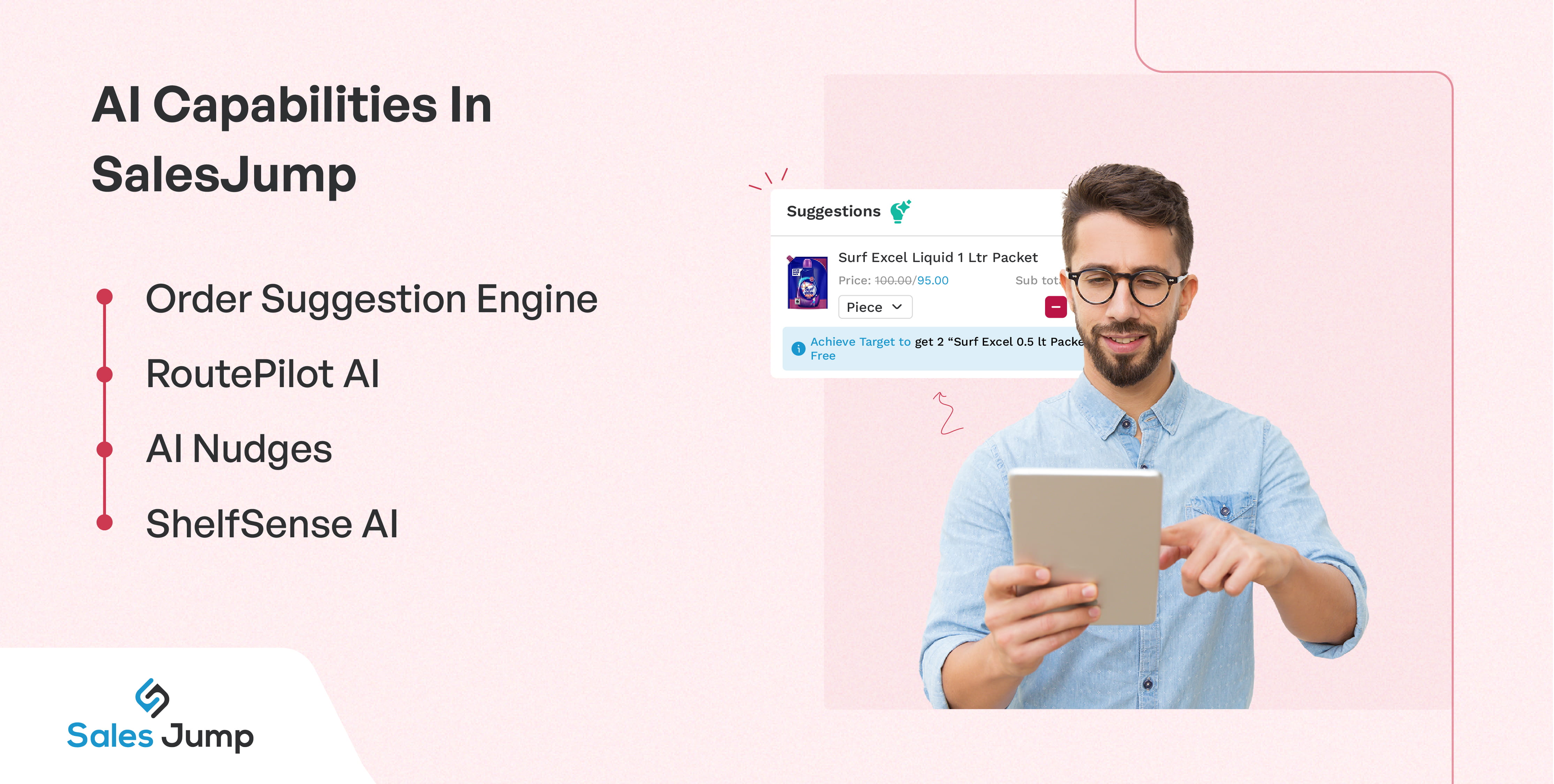
Artificial intelligence in sales is no longer about simply automating repetitive tasks. For field-sales teams, its real value lies in helping reps and managers make better decisions at the right time.
For FMCG, CPG, retail, dairy and distribution-led businesses, every day brings hundreds of decisions: which outlet to visit, what products to recommend, how to optimize the route, which target needs attention and whether merchandising standards are being met.
Traditional Sales Force Automation (SFA) systems can capture these activities. AI can take the next step by turning that data into practical recommendations and timely actions.
SalesJump brings AI into these critical field-sales moments — helping teams decide better, optimize field activity, act on important signals and verify execution.
What Is AI-Powered SFA Software?
AI-powered SFA Software combines sales data, business rules, field activity and AI-driven recommendations to help sales teams make better decisions and execute them more efficiently.
Traditional SFA helps teams manage and record activities such as:
✔ Planning field visits
✔ Tracking attendance
✔ Recording orders
✔ Managing retailers
✔ Monitoring targets
✔ Reporting field activities
AI can add another layer of intelligence by helping answer:
✔ What should I sell?
✔ Where should I go?
✔ What needs my attention now?
✔ What should I do differently?
✔ Did the planned execution actually happen?
This changes SFA from being primarily a system of record into a system that can also support decision-making.
The SalesJump AI Framework
SalesJump's AI capabilities can be understood through four stages:
Decide → Optimize → Act → Verify
Decide
What should the rep do?
AI Order Suggestions can help reps identify relevant products or order opportunities using available sales and business inputs.
Optimize
What is the most efficient way to execute it?
RoutePilot AI helps field teams create more effective routes and outlet sequences.
Act
What needs attention right now?
AI Nudges can surface important targets, gaps, activities and opportunities so reps can focus on timely actions.
Verify
Did the planned execution happen?
ShelfSense AI can help analyze field-captured shelf and merchandising information to identify execution gaps.
Together, these capabilities connect intelligence with field execution.
1. Order Suggestion Engine: Make Every Outlet Conversation More Relevant
One of the most important decisions a field rep makes is also one of the most frequent:
What should I recommend to this retailer?
A rep may have access to purchase history and product information, but manually interpreting every retailer's buying pattern is difficult, especially across a large territory.
How SalesJump AI Helps
SalesJump can use relevant sales and business inputs such as:
✔ Retailer purchase history
✔ Buying patterns
✔ Product relevance
✔ Scheme eligibility
✔ Business rules
to generate order suggestions that can support the rep during the selling process.
Instead of approaching every outlet with the same recommendation, the rep can have more context around what may be relevant to that retailer.
The Business Value
More relevant recommendations can help teams identify additional selling opportunities, improve product mix and make retailer calls more productive.
The objective is not to replace the rep's judgment.
It is to reduce the guesswork around the next product or order opportunity.
2. RoutePilot AI: Optimize the Field Day, Not Just the Route
A sales rep can have a perfectly planned list of outlets and still lose valuable time travelling between them.
In field sales, route efficiency directly affects how much time a rep can spend in the market.
How SalesJump AI Helps
RoutePilot AI helps field teams create more efficient routes and outlet sequences.
Instead of treating every outlet as an isolated visit, route optimization can help determine a more practical sequence for the day's activities.
The Business Value
More efficient routes can contribute to:
✔ Reduced travel time
✔ Better outlet coverage
✔ More productive time in the market
✔ Potential fuel efficiency
✔ Better utilization of field resources
The value of route optimization is not simply finding the shortest path.
It is helping the field team spend more of its working day where it matters.
3. AI Nudges: Turn Sales Signals Into Timely Actions
A dashboard can tell a sales manager what happened.
A report can show what is behind the target.
But field teams often need a more immediate answer:
What should I act on now?
This is where AI Nudges become valuable.
SalesJump AI Nudges are designed around business-use cases rather than functioning as simple reminders.
They can help surface signals related to:
✔ Target gaps
✔ Achievement
✔ Important field activities
✔ Missed opportunities
✔ Time-sensitive actions
✔ Sales execution priorities
From Information to Action
Imagine a rep managing dozens of outlets.
Some need a follow-up.
Some are falling behind.
Some may have an opportunity based on their buying pattern.
Some activities may have been missed.
The challenge is knowing which one deserves attention first.
AI Nudges can bring relevant priorities closer to the rep at the right moment.
The Business Value
The purpose of an AI nudge is not to send more notifications.
It is to help the field team focus on the right action at the right time.
4. ShelfSense AI: Bring Intelligence to Retail Execution
Sales execution does not end when the order is taken.
For FMCG and retail businesses, what happens on the shelf matters too.
Is the product visible?
Is the expected merchandising execution happening?
Are there gaps that need attention?
Manually checking these things across a large retail network can be time-consuming and difficult to standardize.
How SalesJump AI Helps
ShelfSense AI can use field-captured visual information to support merchandising and shelf audits.
The capability can help identify execution gaps based on defined merchandising or business requirements.
The Business Value
AI-assisted shelf auditing can help businesses:
✔ Improve retail visibility
✔ Identify execution gaps faster
✔ Standardize parts of the audit process
✔ Monitor merchandising compliance
✔ Reduce reliance on entirely manual checks
This connects field activity with what is actually happening at the point of sale.
Not Every Intelligent Feature Needs to Be Called AI
There is an important distinction between intelligent functionality and AI functionality.
For example, retailer color coding or outlet prioritization can use sales performance, order activity, target achievement and business rules to help teams classify or prioritize outlets.
That makes the capability useful and data-driven.
But it should not automatically be labelled AI unless AI is actually involved in the underlying process.
This distinction matters.
AI should not be used as a marketing label for every feature that uses data.
The more clearly an SFA platform explains where AI is actually being used, the easier it is for buyers to understand and trust its capabilities.
AI for Sales Reps vs AI for Sales Managers
AI can support different decisions at different levels of the organization.
| For Sales Reps | For Sales Managers |
|---|---|
| What should I recommend? | Where are the biggest opportunities? |
| Which outlets should I prioritize? | Which teams or territories need attention? |
| What should I act on today? | Where are targets at risk? |
| Is my route efficient? | How effectively is the field being utilized? |
| What needs to be fixed at the outlet? | Where are execution gaps occurring? |
For reps, AI can reduce the effort required to decide what to do next.
For managers, it can help turn large volumes of field data into clearer priorities.
What Makes Practical AI Different From AI for the Sake of AI?
Not every business needs AI to perform every task.
The better question is:
Where can AI remove uncertainty from a field-sales decision?
For FMCG and distribution-led businesses, some of the most valuable decisions happen repeatedly:
✔ Which outlet should I prioritize?
✔ What should I recommend?
✔ How should I plan my route?
✔ What target gap needs attention?
✔ Which opportunity may be getting missed?
✔ Is the planned merchandising execution happening?
These are practical problems.
And practical AI should solve practical problems.
SalesJump's approach is therefore not about replacing the sales rep with AI.
It is about giving the rep better information and recommendations at the moments when decisions need to be made.
What Should FMCG Companies Look for in an AI-Powered SFA?
AI capabilities can look impressive on a product page. But businesses evaluating an AI-powered SFA should look beyond the label.
1. Does the AI solve a real field problem?
A recommendation is valuable only when it helps the rep or manager make a better decision.
2. Is the recommendation connected to business data?
AI should work with relevant sales, retailer, field and business inputs rather than operating in isolation.
3. Does AI fit into the existing workflow?
Field teams should not need to switch between multiple systems just to use an AI capability.
4. Can the business understand what the AI is helping with?
Clear use cases are more useful than vague claims about intelligence.
5. Can the impact be measured?
Businesses should be able to evaluate whether AI is improving the activities it was designed to support.
6. Does AI assist the rep rather than create unnecessary complexity?
The best AI capability may be the one that feels simple to the person using it.
The Future of AI in Field Sales Is Not About Replacing the Rep
Field sales is fundamentally human.
A rep understands the retailer relationship.
A rep can recognize a local market situation.
A rep can negotiate, build trust and respond to circumstances that may not appear in a dataset.
AI brings a different strength.
It can process large volumes of information, identify patterns, optimize activities and surface relevant signals.
The opportunity is not to choose between the two.
It is to combine them.
AI can help determine what deserves attention.
The rep decides how to act on it.
That is where AI becomes practical for field sales.
Why SalesJump AI?
SalesJump brings AI into the everyday decisions that shape field-sales execution.
From order suggestions and route optimization to proactive nudges and AI-powered shelf audits, its AI capabilities are designed around real field-sales situations.
The goal is simple:
Less guesswork.
Better decisions.
More actionable field execution.
For FMCG, CPG, retail, dairy and distribution-led businesses, AI becomes most valuable when it moves beyond dashboards and becomes part of the decisions made every day in the market.
See how SalesJump brings practical AI into everyday field-sales execution.
Request a SalesJump Demo
Frequently Asked Questions
1. What is AI-powered sales force automation?
AI-powered Sales Force Automation uses sales and field data with AI-driven recommendations or analysis to help sales teams prioritize activities, make decisions and improve field execution.
2. How does AI improve field sales?
AI can help identify opportunities, recommend actions, optimize routes, surface important sales signals and support retail execution.
3. What are AI nudges in sales?
AI nudges are timely prompts or recommendations based on relevant sales and field signals, helping reps focus on actions that require attention.
4. Can AI improve sales productivity?
AI can reduce decision-making effort, prioritize field actions and support planning and analysis. The actual business impact should be measured using relevant customer and field-performance data.
5. What should an FMCG company look for in an AI-powered SFA?
Look for practical AI use cases, relevant business data, field usability, measurable outcomes, clear recommendations and AI capabilities that fit naturally into existing sales workflows.