 Author : Komalalakshmi M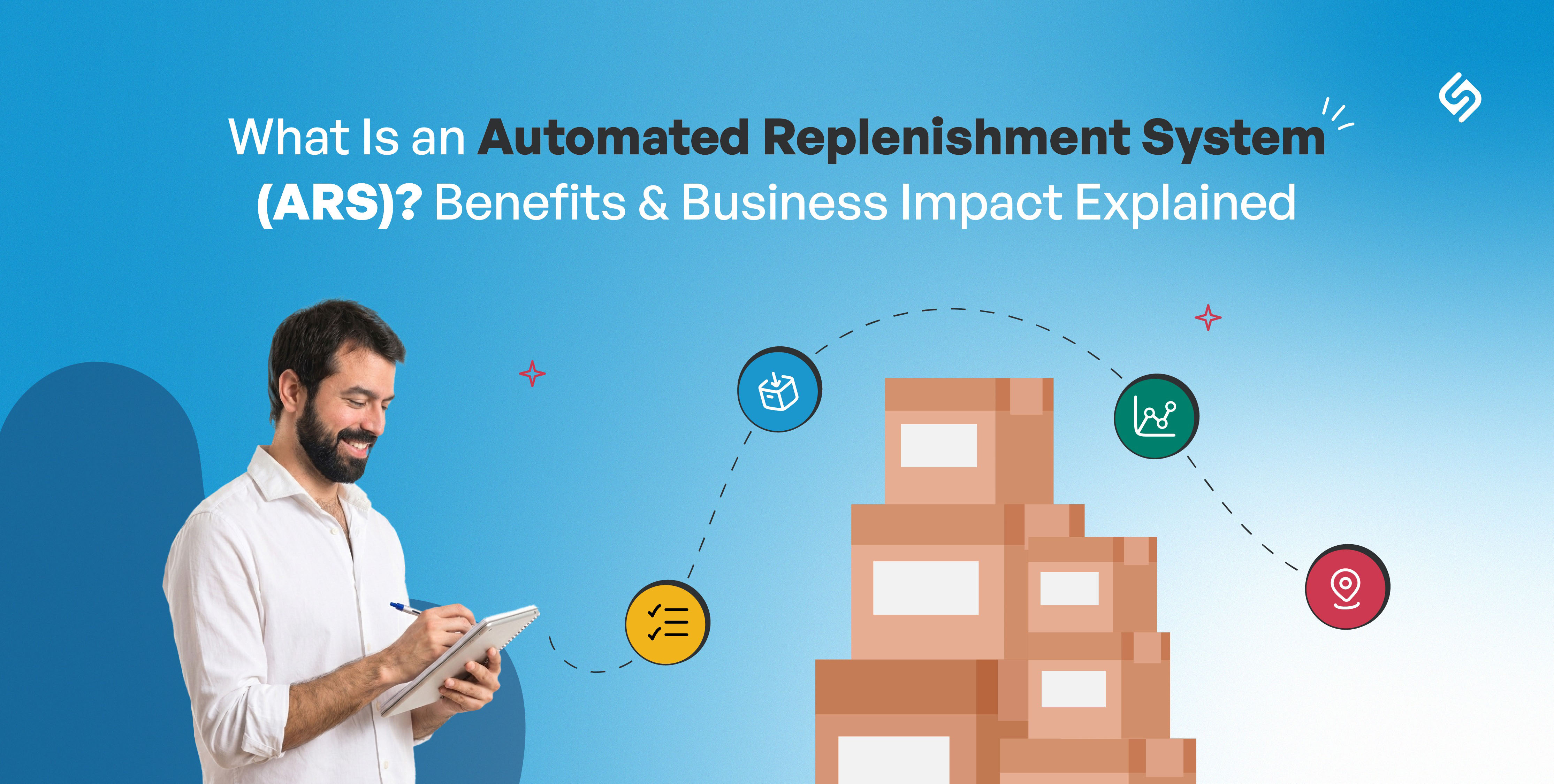
A customer walked into a supermarket to buy her usual packet of biscuits and headed straight to the shelf. It was empty. She didn’t wait, she didn’t ask the store manager, she simply picked a competitor’s brand sitting right beside it. In that moment, the brand didn’t just lose one sale; it potentially lost repeat purchases, brand recall, and maybe even a loyal customer. What’s more surprising is that the product wasn’t actually out of stock in the company’s system. Cartons of the same biscuits were sitting at the distributor’s warehouse. The real problem wasn’t production or demand-it was replenishment.
In fast-moving consumer goods, availability equals revenue.
If your product isn’t on the shelf, your competitor wins.
This is exactly the gap an Automated Replenishment System (ARS) is built to solve.
What Is an Automated Replenishment System (ARS)?
An Automated Replenishment System (ARS) is a data-driven inventory solution that automatically determines:
✔ What to reorder
✔ When to reorder
✔ How much to reorder
It uses real-time sales data, stock levels, lead time, and demand patterns to generate replenishment orders without manual intervention. By integrating with Inventory Tracking systems and Order Management platforms, ARS can automatically monitor stock levels and trigger replenishment orders when inventory reaches predefined thresholds.
Instead of planners depending on spreadsheets or phone calls, ARS continuously monitors inventory across:
✔ Warehouses
✔ Distributors
✔ Retail networks
And triggers replenishment at the optimal time.
In simple terms:
✔ Manual ordering reacts
✔ ARS predicts
Why FMCG Companies Cannot Rely on Manual Replenishment Anymore
| FMCG operates in: | Manual ordering leads to: |
|---|---|
| High SKU complexity | Frequent stock-outs |
| Fast-moving consumption cycles | Excess safety stock |
| Seasonal spikes | Dead inventory |
| Promotion-driven volatility | Emergency dispatch costs |
| Multi-tier distribution networks | Blocked working capital |
Even a small 3–5% stock-out rate can significantly impact revenue across high-volume SKUs.
The real issue isn’t production capacity.
It’s replenishment timing.
The Strategic Role of ARS in FMCG
An Automated Replenishment System shifts the business from:
✔ Reactive supply → Predictive supply
Here’s what that means strategically:
1. Shelf Availability Becomes Measurable and Controlled
ARS ensures fast-moving SKUs are replenished before depletion.
More availability = More billing = More revenue capture.
2. Inventory Is Optimized, Not Just Stored
Instead of overstocking slow-moving products and understocking fast movers, ARS balances inventory using consumption data.
Result:
✔ Lower holding cost
✔ Reduced warehouse congestion
✔ Faster inventory turnover
3. Working Capital Improves
Excess inventory ties up cash.
ARS reduces unnecessary stock build-up while protecting availability.
That frees capital for:
✔ Marketing campaigns
✔ Trade schemes
✔ Expansion
How an Automated Replenishment System Works in FMCG
Let’s break it down simply:
Step 1: Data Collection
Sales data flows in from distributors or retail billing systems.
Step 2: Consumption Analysis
The system calculates average sales velocity per SKU.
Step 3: Reorder Level Calculation
It considers:
✔ Lead time
✔ Minimum stock threshold
✔ Buffer stock
Step 4: Automated Trigger
When stock approaches the reorder point, the system generates a replenishment recommendation or order automatically.
Step 5: Continuous Adjustment
If sales spike due to seasonality or promotion, ARS adapts dynamically.
✔ No panic calls
✔ No emergency transport costs
✔ No guesswork
Before vs After ARS: The Real Difference
| Before ARS | After ARS |
|---|---|
| Sales teams manually follow up for stock | Data-driven replenishment cycles |
| Frequent out-of-stock complaints | Improved fill rates |
| High safety stock across distributors | Reduced emergency dispatch |
| Unplanned logistics expenses | Optimized distributor inventory |
| Slow-moving inventory buildup | Higher sell-through rates |
The shift is operational - but the impact is financial.
Key Business Benefits of ARS for FMCG Brands
✨ Reduced Stock-Outs:
Ensures top SKUs remain available across markets.
✨ Improved Inventory Turnover:
Stock moves faster instead of sitting idle.
✨ Lower Holding Costs:
Optimal ordering reduces excess accumulation.
✨ Higher Fill Rates:
Distributors receive stock on time with fewer gaps.
✨ Stronger Distributor Relationships:
Automation reduces friction and improves coordination.
✨ Better Data Visibility:
Leadership gets clearer insights into consumption trends.
Common Misconceptions About Automated Replenishment
It replaces supply chain planners.
No. It enhances their role. Instead of spending time on manual data entry, planners can focus on analysis and strategic decision-making.
It only works for large FMCG companies.
Not true. Mid-sized FMCG brands often benefit even more, as automation helps reduce stock inefficiencies and improve inventory control.
It’s difficult to implement.
With structured rollout and clean data integration, ARS can be implemented in phases, usually starting with high-performing SKUs.
Implementation Blueprint for FMCG Companies
If you are considering ARS, a practical approach includes:
✔ Assess current stock-out and excess inventory levels
✔ Identify high-impact SKUs (top revenue drivers)
✔ Define reorder rules for each SKU
✔ Integrate sales and inventory data
✔ Pilot the system in one region
✔ Track KPIs such as fill rate, stock-outs, and inventory turnover
✔ Gradually scale across markets
Start small and scale strategically.
The Bigger Picture: ARS as a Competitive Advantage
In FMCG, strong distribution determines market success. Brands may invest heavily in advertising, promotions, and trade schemes, but if products are not available on shelves, that demand shifts to competitors.
An Automated Replenishment System helps protect revenue by ensuring the right product is available in the right quantity, at the right place, and at the right time.
Strategic Advantage of Automated Replenishment
FMCG growth is not only about increasing sales; it is also about preventing lost sales.
Automated Replenishment transforms inventory management from an operational task into a strategic advantage. In a market where shelf availability drives purchase decisions, automation is no longer optional-it is essential.