
 Author : Komalalakshmi M
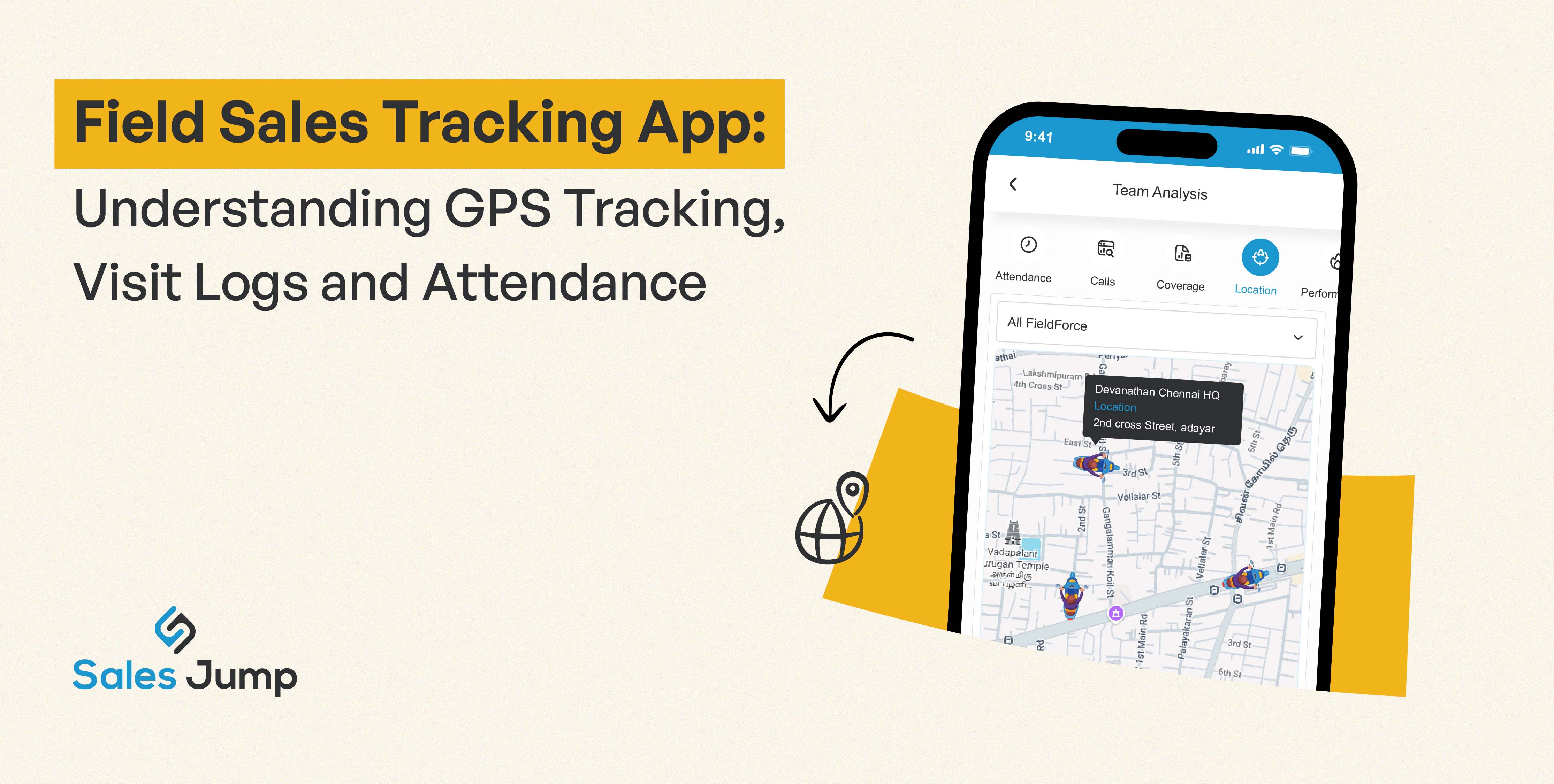
Your field team made 400 outlet visits yesterday. How many can you prove actually happened, and what did each one sell?
For most FMCG and consumer-goods sales heads, the honest answer is "we'll know when the reports come in." By then the beat is missed, the stock-out has cost a sale, and the travel claim is already filed.
A field sales tracking app closes that gap. It puts GPS-verified attendance, beat plans, order booking and live dashboards into one mobile app, so managers see field work as it happens, not at month-end. This guide covers what to look for, and how SalesJump puts it to work across reps, distributors and retailers.
Why Field Sales Visibility Breaks Down
Field sales happen in markets, kirana lanes and distributor godowns, far from the manager's desk. Without a tracking layer, five gaps open up.
1. Reports prove submission, not visits
End-of-day call reports and spreadsheets confirm that a report was filed. They cannot confirm the rep stood in the outlet.
2. The volume is too high to log by hand
An FMCG rep may cover 15 to 25 outlets a day and 80 to 150 outlets across a beat cycle. Manual notes at that pace are late, partial or skipped.
3. elling time leaks into admin
Salesforce's State of Sales research finds reps spend only about 40% of their time actually selling. The rest goes to data entry, reporting and travel.
4. Order data arrives late
Paper order books and WhatsApp photos reach the distributor hours or days later, with errors in SKUs, schemes and quantities.
5. Expenses don't match the road
Travel allowances are claimed on declared kilometres, not on the route the rep actually took.
The cost is not just lost visibility. Beat plans, territory design and sales forecasts are all built on visit data, so bad data leads to bad planning decisions.
What a Field Sales Tracking App Actually Does
A field sales tracking app is a mobile app for reps, paired with a web dashboard for managers. It records where each rep is, which outlets they visited, how long they stayed and what they booked, with a GPS location and timestamp on every action.
Here is how a typical day runs on one:
✨ Day Start
The rep punches in from the app. Attendance is geo-tagged, so the manager knows when and where the day began.
✨ Beat Opens
The day's outlet list loads from the assigned beat plan, in visit order.
✨ Outlet Check-In
The rep checks in at the shop. A geofence confirms they are actually at the outlet's mapped location.
✨ Work at the Outlet
The rep books the order with live prices and schemes, clicks shelf photos, and records payment collection.
✨ Check-Out
Time spent at the outlet is logged automatically, and the next outlet loads.
✨ Day Close
Expenses are submitted with receipts. Distance travelled comes from the GPS trail, not from memory.
While this runs, the manager watches it live: who is on the field, which outlets are covered, and how actual visits compare to the plan.
10 Must-Have Features in Field Sales Tracking Software
Many tools show a dot on a map. Few connect that dot to the order, the outlet and the expense claim. Use this checklist when you evaluate any vendor.
| # | Feature | Why It Matters | What to Check in a Demo |
|---|---|---|---|
| 1 | Live GPS tracking and route history | See where reps are now and where they went | Replay a rep's full day on a map |
| 2 | Geo-tagged attendance | Stops proxy punches and late starts | Punch-in shows time, location and photo |
| 3 | Geofenced check-in and check-out | Proves the rep was at the outlet | Check-in blocked outside the outlet radius |
| 4 | Beat and route planning | Every outlet visited at the right frequency | Plan vs actual coverage by rep |
| 5 | Mobile order booking | Clean orders with correct SKUs, prices and schemes | Order reaches the distributor instantly |
| 6 | Offline-first sync | Works in tier-2, tier-3 and rural markets | Book an order in airplane mode, then sync |
| 7 | Expense and claims management | Claims tied to real distance and receipts | Approval flow across the hierarchy |
| 8 | Retail execution and merchandising | Shelf share and display compliance on record | Photo capture tagged to outlet and time |
| 9 | Dashboards and reports | Spot gaps before they hit monthly numbers | Drill down from region to rep to outlet |
| 10 | Integrations and role-based access | One source of truth, the right data per role | Tally, ERP, DMS and BI connectors |
If a tool misses features 3, 5 or 6, it will track movement but not sales. Those three turn a location tracker into a sales tool.
How SalesJump Puts Every Field Hour on Record
SalesJump is an AI-powered sales force automation (SFA) platform built for FMCG, CPG, dairy and retail businesses. It covers each of the 10 features above, and connects the rep's app to distributors and retailers on the same platform.
Field Force Tracking and Geo-Tagged Attendance
SalesJump tracks every rep by GPS and tags each location they log. Attendance is marked from the mobile app with a geo-tag, and leave requests are raised and approved in the same app. Managers see who started the day, from where, and when.
Geofencing with Auto Check-In and Check-Out
Set a virtual boundary around each retailer. SalesJump records check-in and check-out automatically when the rep enters and leaves the outlet. Every visit carries a time on site, so a reported visit can be told apart from a real one.
Beat Planning and Route Optimisation
Build daily beats by territory and visit frequency, then assign them to reps. Route optimisation suggests a visit order that cuts travel time, and plan-vs-actual reports show which outlets were skipped.
Order Management with AI Order Suggestions
Reps book orders on the spot with flexible pricing and live inventory sync. AI-powered order suggestions help the rep pitch the right SKUs and quantities for each outlet. Orders reach the distributor instantly, with invoicing linked to order placement.
Expense and Claims Management
Reps submit expenses with receipt uploads, and automated rules route them for approval. Expense and incentive claims are reconciled in one place, against the route the rep actually travelled.
In-Store Merchandising and Retail Execution
Field agents upload merchandising data and store photos during the visit. Display compliance and shelf presence become records you can audit, not claims you have to trust.
Distributor Management and the Retailer App
SalesJump DMS gives distributors real-time insight into inventory, order fulfilment and delivery. The SalesJump Retailer App lets retailers place orders, track deliveries and check product information themselves. Rep, distributor and retailer data all meet on one platform.
Van Sales, Delivery and Payment Collection
For van-based selling, SalesJump supports on-van inventory, billing and mobile invoicing. The delivery module schedules and tracks deliveries with proof of delivery. Reps can record payment collections at the outlet.
Dashboards, Reports and Role-Based Access
Real-time dashboards show sales and performance across teams and regions. Reports cover orders, visits, achievements, delivery and visit frequency. Role-based access decides who sees which data, from the regional head down to the rep.
Offline Mode and Integrations
Reps can take and submit orders even on a poor network, and data syncs once the device reconnects. SalesJump connects with Tally, ERP, CRM and BI tools, and offers an API for custom links.
Built for FMCG, Dairy, Retail and Consumer Goods
Each industry sells through the field differently. SalesJump fits the workflow each one already runs.
| Industry | Field Challenge | How SalesJump Fits |
|---|---|---|
| FMCG and CPG | Thousands of outlets, tight beats, scheme-heavy orders | Beat planning, geofenced visits, scheme-aware order booking, DMS for secondary sales |
| Dairy | Daily route-based distribution with short shelf life | SalesJump GoDairy for milk distribution: routes, real-time tracking and inventory |
| Retail and modern trade | Display compliance and promoter productivity | Merchandising photos, promoter tasks, audits and attendance |
| Consumer goods and durables | Dealer coverage across wide territories | Live tracking, route optimisation, Retailer App for self-ordering |
Manual Reporting vs SalesJump
| Area | Manual Reporting | With SalesJump |
|---|---|---|
| Attendance | Phone call or WhatsApp "reached" message | Geo-tagged punch-in from the app |
| Visit proof | Self-reported call sheet | Geofenced auto check-in and check-out with time on site |
| Beat adherence | Checked at month-end, if at all | Plan vs actual coverage, live |
| Orders | Paper book, keyed in later | Booked in-app, sent to the distributor instantly |
| Low network | Data waits until the rep is back | Offline booking, auto-sync on reconnect |
| Expenses | Declared kilometres and loose bills | GPS distance, receipt uploads, rule-based approval |
| Retail execution | "Display done" on trust | Store photos tagged to outlet and time |
| Manager view | Spreadsheets compiled weekly | Real-time dashboards from region to outlet |
Frequently Asked Questions
Frequently Asked Questions
1. What is a field sales tracking app?
It is a mobile app that records where field reps are, which outlets they visit, how long they stay and what they sell. Managers see this live on a web dashboard.
2. How is it different from a GPS tracker?
A GPS tracker shows location only. Field sales tracking software ties that location to attendance, outlet visits, orders, collections and expenses, so you see sales activity, not just movement.
3. Does SalesJump work without internet?
Yes. Reps can book and submit orders on a poor network, and data syncs once the phone reconnects.
4. Can SalesJump verify that a rep really visited an outlet?
Yes. Geofencing around each retailer, with automatic check-in and check-out, confirms the rep was on site and records the time spent there.
5. Will reps see tracking as micromanagement?
Not when it saves them work. With SalesJump, the app fills their call report, order book and expense claim for them, so tracking replaces paperwork instead of adding to it.
6. Does SalesJump integrate with Tally or our ERP?
Yes. SalesJump connects with Tally, ERP, CRM and BI tools, and provides an API for custom integrations.