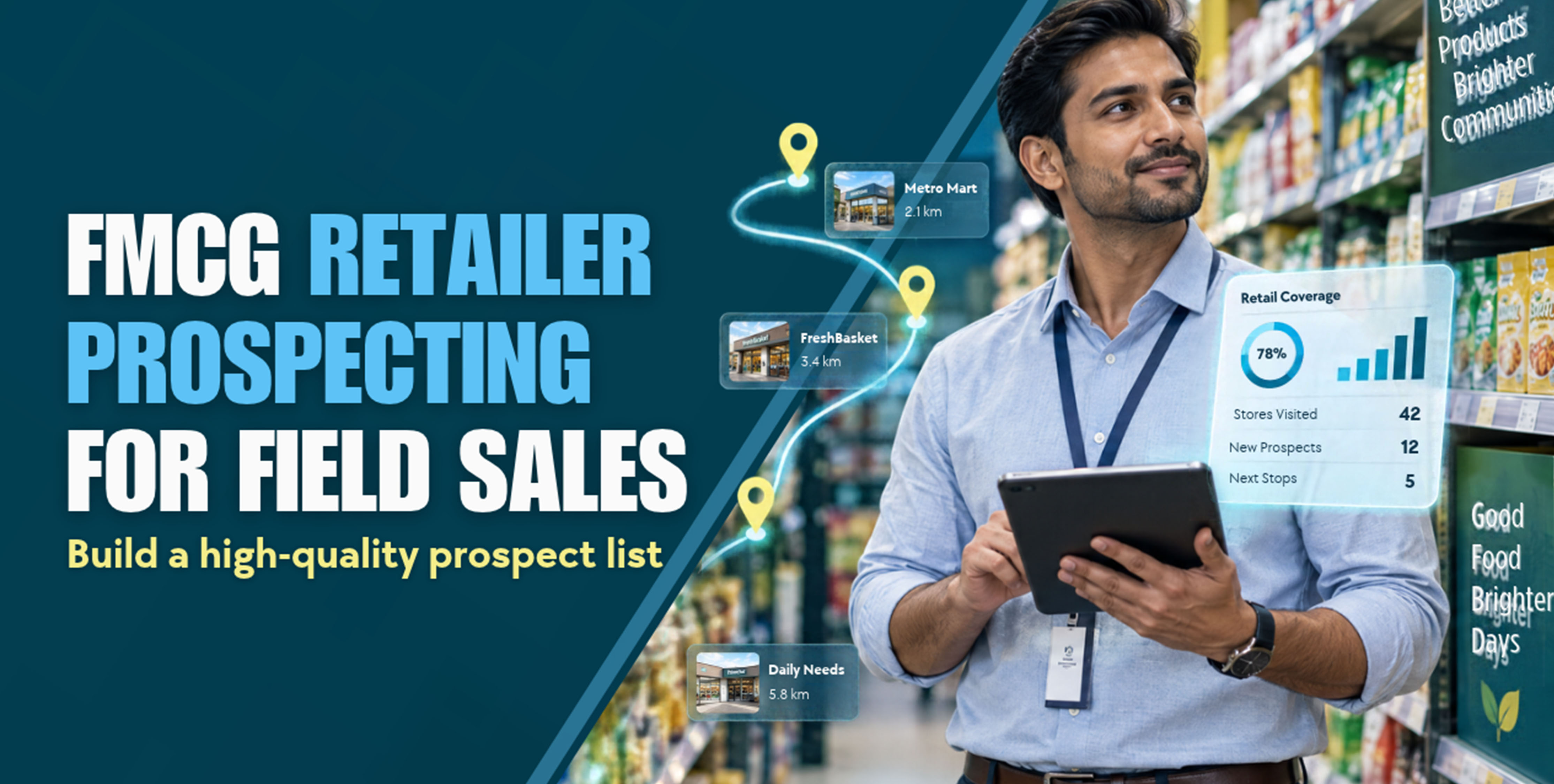
For an FMCG brand, growth depends on more than having a good product. The product also needs to reach the right retailers, distributors, and outlets and stay available once it gets there.
That makes retailer prospecting an important part of field sales. A well-built prospect list helps sales representatives focus on outlets that fit the brand, plan more productive visits, and follow up consistently. A weak list, on the other hand, can lead to wasted travel, missed opportunities, and poor territory coverage.
The goal is not to collect the largest possible number of store names. It is to identify promising accounts, understand who makes or influences buying decisions, and give field teams useful information before they visit.
1. Define the retailer profile you want to target
Start by describing the types of retailers most likely to stock and sell your products. This is your ideal retailer profile.
Depending on your product and route to market, relevant criteria may include:
✔ Retail format, such as convenience stores, supermarkets, independent grocers, pharmacies, or specialty stores.
✔ Product category and fit.
✔ Store size and likely sales potential.
✔ Geographic location and distance from your distribution network.
✔ Number of branches or outlets.
✔ Customer profile and shopping patterns.
✔ Existing brands or competing products carried.
✔ Access to a suitable distributor or delivery route.
✔ Seasonal or local demand patterns.
For example, a premium personal-care brand may prioritize pharmacies and beauty retailers, while a low-priced snack brand may focus on convenience stores and high-footfall neighborhood outlets.
The more clearly you define your target, the easier it becomes for your team to distinguish a high-potential prospect from an outlet that is unlikely to be a good fit.
2. Decide which channel and account types to pursue
FMCG brands may sell through several routes to market. Your prospect list should reflect the channels that matter to your business.
Potential targets include:
✔ Independent retail outlets.
✔ Regional or national retail chains.
✔ Wholesalers and cash-and-carry businesses.
✔ Distributors and sub-distributors.
✔ E-commerce retailers.
✔ Specialty stores.
✔ Food-service or hospitality buyers, where relevant.
These account types have different buying processes. An independent retailer may make stocking decisions in-store, while a retail chain may require approval from a category manager or central procurement team. A distributor may evaluate your product based on demand, margins, delivery requirements, and territory potential. Separate prospects by channel so your sales team can use an appropriate approach for each group.
3. Map the decision-makers and buying process
Knowing the outlet is only part of the job. Your team also needs to understand who decides whether to stock a product and how that decision is made.
Depending on the account, relevant contacts may include:
✔ Store owners or managers.
✔ Category or purchasing managers.
✔ Procurement teams.
✔ Regional operations managers.
✔ Distributor owners or sales managers.
✔ Merchandising or replenishment contacts.
Avoid relying on job titles alone. A store manager may influence local product selection but have limited authority over pricing or assortment. At a larger chain, the central buying team may determine which products are listed, while store teams manage shelf placement and replenishment.
Where appropriate, record multiple contacts for an account and note each person’s role in the buying process.
4. Build the account list before planning visits
Create a clean list of target accounts before assigning sales representatives to visit them. Useful account-level information may include:
✔ Retailer or outlet name.
✔ Outlet type and channel.
✔ Address, city, and territory.
✔ Parent company or chain name.
✔ Number of branches, if known.
✔ Distributor or delivery coverage.
✔ Relevant contact names and roles.
✔ Product-category fit.
✔ Current relationship or account status.
✔ Potential reason to approach the account.
✔ Last research or verification date.
For outlet-based selling, accurate location information is especially important. A prospect list should help representatives determine where an outlet is, which territory it belongs to, and whether it can be served efficiently.
Before adding a location to a route, verify that the outlet is active and that the address is correct. Duplicates, closed stores, and incomplete addresses can undermine even a well-planned field-sales program.
5. Gather information that supports a useful sales conversation
Collect enough information to help a representative prepare, without filling the record with data that will never be used.
For a retailer prospect, useful details might include:
✔ Store format and estimated size.
✔ Relevant product categories.
✔ Existing brands or products in the category.
✔ Likely sales or footfall potential.
✔ Current supplier or distributor, where known.
✔ Delivery and ordering preferences.
✔ Shelf, display, or merchandising requirements.
✔ Buying cycle or preferred contact time.
✔ Previous visits, conversations, and next steps.
A short, specific note can be more valuable than a long record of generic details. For example: “Carries two competing snack brands; owner asked about smaller case sizes” gives a representative a clear follow-up opportunity.
6. Verify and maintain retailer data
Retail information changes. Stores open, close, relocate, change ownership, or update their purchasing arrangements. Contact details can also become outdated. Establish a process for checking important records before outreach and updating them after field visits. Representatives should be able to flag:
✔ Closed or relocated outlets.
✔ Incorrect contact information.
✔ Duplicate accounts.
✔ Changed ownership or management.
✔ New branches.
✔ Updated buying or delivery arrangements.
✔ Accounts that have asked not to be contacted.
Where information comes from third-party data sources, confirm that it is relevant to the target market and suitable for the intended use. Do not assume a company-level record automatically confirms that a specific store is open, reachable, or ready to buy.
7. Prioritize prospects by potential and fit
Not every outlet should receive the same amount of sales time. Use a simple scoring system to help prioritize accounts.
A retailer score might consider:
✔ Fit with the product category.
✔ Outlet type and customer profile.
✔ Location within a serviceable territory.
✔ Estimated sales potential.
✔ Number of branches.
✔ Distribution feasibility.
✔ Current category assortment.
✔ Interest shown during previous contact.
✔ Time since the last visit.
✔ Likelihood of a near-term buying opportunity.
The purpose of scoring is not to predict sales perfectly. It is to help managers and representatives decide where to focus first, how often to visit, and which accounts may need additional support.
Review the scoring criteria as sales data comes in. If high-scoring prospects do not convert, or lower-scoring outlets consistently perform well, adjust the model.
8. Use sales force automation to turn lists into field activity
A prospect list is most useful when it connects to the day-to-day work of the field team. Sales force automation (SFA) tools can help manage accounts, visits, tasks, and follow-ups in one workflow.
Depending on the platform, SFA capabilities may help teams:
✔ Assign accounts to territories and representatives.
✔ Plan and optimize visit schedules.
✔ Record check-ins, visit notes, and outcomes.
✔ Set follow-up reminders.
✔ Track orders, samples, and sales opportunities.
✔ Monitor outlet coverage and visit frequency.
✔ Share updates between field representatives and managers.
✔ Review performance by territory, channel, or product.
The quality of the information entered by representatives matters. Keep forms practical and focused on details that help the next visit or support better decisions. If data entry is too burdensome, updates may become incomplete or delayed.
9. Make every visit purposeful
A field visit should have a clear objective. That might be introducing a new product, securing a first order, checking availability, discussing a promotion, or resolving a service issue.
Before a visit, the representative should be able to see the account history, previous commitments, open tasks, and any relevant product or distributor information. Afterward, they should record the outcome and agree on the next step.
A consistent visit process helps teams avoid repeated introductory conversations and makes follow-up more reliable. It also gives managers a clearer picture of what is happening across the territory.
10. Use ReachStream for prospect research and data quality
Researching companies and relevant contacts manually can take time, especially when a brand is entering a new region or building a list of distributors, retail chains, and buying contacts. ReachStream can support parts of this process by helping users search company and contact data, build and save prospect lists, enrich records, and verify email addresses, according to its product information.
For FMCG teams, it may be useful for researching retail organizations, distributors, wholesalers, and relevant business contacts as part of prospect preparation. Teams can use filters such as industry, role, location, company size, and other available attributes to narrow their research and organize prospects.
However, company and contact data should not be treated as a substitute for outlet-level verification. Before planning a field visit, confirm that a specific store or location is active, falls within the right territory, and can be served by your distribution network. Check that the data fields and coverage available in ReachStream match your target market and use case.
The strongest process combines prospect research with field knowledge: use data to identify and organize potential accounts, then let representatives validate local conditions and record what they learn.
11. Measure list and field-sales performance
Track whether your prospecting process is creating useful activity and commercial results. Depending on your sales model, useful measures may include:
✔ Target outlets identified and verified.
✔ New accounts contacted.
✔ Visits completed versus planned.
✔ Contact-to-meeting or contact-to-trial rate.
✔ First orders secured.
✔ Repeat-order rate.
✔ Product availability and distribution coverage.
✔ Sales by outlet, territory, or channel.
✔ Follow-up completion.
✔ Time and travel spent per productive visit.
Review these metrics together. A high number of visits is not necessarily a sign of success if the right outlets are not being reached or follow-ups are not resulting in orders.
Use performance data to refine your retailer profile, improve territory plans, and identify where representatives need better information or support.
Final checklist for an FMCG retailer prospect list
Before using your list for field sales, check that:
✔ Target accounts match your product and channel strategy.
✔ Retailers, distributors, and other account types are clearly categorized.
✔ Contact roles and buying processes are understood where possible.
✔ Outlet addresses and operating status have been verified.
✔ Duplicate and outdated records have been removed or flagged.
✔ Prospects are prioritized by fit, potential, and serviceability.
✔ Account information is available to the field team in its SFA workflow.
✔ Each visit has a purpose and a recorded next step.
✔ Performance is measured by meaningful outcomes, not list size alone.
Conclusion
A high-quality retailer prospect list gives FMCG field teams a stronger starting point for growing distribution. It helps them focus on the right accounts, plan visits more effectively, and follow up with the context needed to move a conversation forward. The best results come from combining clear targeting, reliable data, local field knowledge, and consistent use of sales force automation.
Tools such as ReachStream can assist with company and contact research, while field representatives verify outlet-level details and build relationships on the ground. The objective is simple: spend less time searching for prospects and more time developing the retail relationships that can support sustainable growth.