 Author : Francy Wishny G
What is Route-to-Market (RTM) in FMCG?
Developing a great product is only the first step. The real challenge is ensuring it reaches the right stores, at the right time, and is available when customers are ready to buy.
This journey, from manufacturer to consumer, is known as Route-to-Market (RTM).
An RTM strategy defines how products move through distribution channels to reach customers efficiently, ensuring better product availability, market reach, and business growth.
Did You Know?
Nearly 80–90% of FMCG sales worldwide still happen through offline retail channels, making an effective Route-to-Market strategy essential for ensuring products remain consistently available where customers shop and maximizing market reach.
What Does a Route-to-Market Strategy Determine?
A Route-to-Market strategy shapes how a product reaches the market and how effectively it can be sold.
It helps businesses determine:
✔ Where to sell - the markets and outlets to target.
✔ How to sell - the right sales and distribution channels.
✔ Who to serve - the retailers and customer segments to prioritize.
✔ How to reach them - the distribution network and field coverage required.
✔ How to measure performance - the sales and distribution metrics to track.
✔ Getting these decisions right helps businesses build a distribution model that matches their products, customers, and market conditions.
For Instance,
Imagine a customer visiting a supermarket to buy their preferred snack brand.
If it's available, the purchase happens.
If it's out of stock, they often choose a competing brand.
This is why an effective Route-to-Market strategy focuses on keeping products consistently available across retail outlets.
How Does Route-to-Market Work?
While every FMCG business follows a different distribution model, the objective remains the same, delivering products to customers quickly, efficiently, and consistently.
A typical Route-to-Market process looks like this:
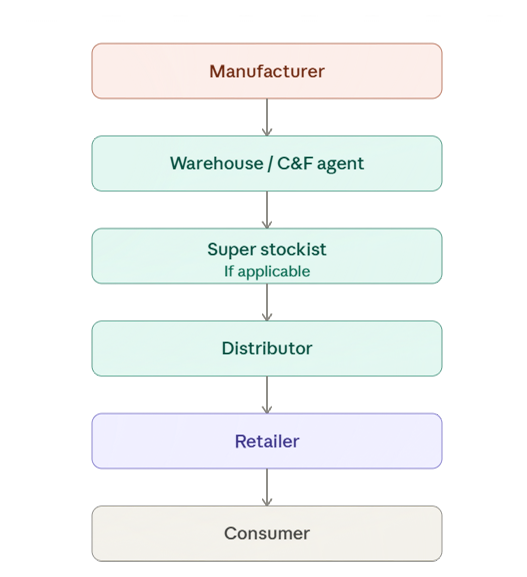
Each stage plays a vital role in ensuring products move efficiently through the supply chain before reaching the end customer.
Depending on the business model, product category, and distribution strategy, some stages may be combined or omitted. However, every successful Route-to-Market strategy is built around one common goal: ensuring products are available where customers expect to find them.
Key Components of an FMCG Route-to-Market Strategy
A successful Route-to-Market strategy involves more than simply moving products from one location to another. It requires careful planning, efficient execution, and continuous monitoring to ensure products reach the right customers at the right time.
Below are the key components that shape an effective RTM strategy.
Distribution Network
The distribution network forms the backbone of any Route-to-Market strategy. It defines how products move from manufacturers to warehouses, distributors, wholesalers, retailers, and ultimately to consumers.
A well-structured distribution network helps businesses improve product availability, reduce delivery delays, and serve markets more efficiently.
Sales Channels
FMCG businesses often use multiple sales channels to maximize market coverage and reach different customer segments.
Common sales channels include:
✔ General Trade.
✔ Modern Trade.
✔ Wholesale.
✔ E-commerce.
✔ Direct-to-Consumer (D2C).
✔ HoReCa.
The right mix of channels depends on the product category, target audience, and overall business objectives.
Field Sales Execution
An effective RTM strategy doesn't end once products are distributed.
Field sales teams play a crucial role in ensuring products are available, visible, and well-positioned across retail outlets. Their responsibilities often include order collection, retailer servicing, stock monitoring, merchandising, and executing promotional activities.
Consistent field execution helps improve retailer relationships while ensuring products remain available to consumers.
Demand Planning
Accurate demand planning enables businesses to anticipate customer demand and maintain the right stock levels across the distribution network.
By analyzing historical sales data, seasonal trends, and market demand, businesses can reduce stock shortages, avoid excess inventory, and improve overall supply chain efficiency.
Performance Monitoring
An effective Route-to-Market strategy requires continuous evaluation.
Businesses regularly monitor key performance indicators (KPIs) such as sales performance, outlet coverage, product availability, distributor performance, order fulfillment, and market execution to identify opportunities for improvement.
These insights help businesses make informed decisions and continuously optimize their distribution strategy.
Did You Know?
An ineffective Route-to-Market strategy can lead to stock-outs, delayed deliveries, poor shelf availability, and lost sales opportunities; even when customer demand is high.
Common Route-to-Market Models in FMCG
There is no one-size-fits-all approach to Route-to-Market.
The right model depends on factors such as business size, product category, market coverage, and distribution strategies. Many businesses even combine multiple models to serve different markets more effectively.
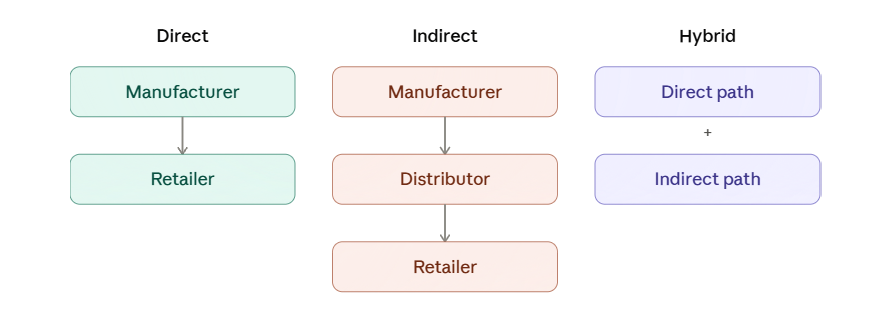
Direct Distribution
In this model, manufacturers sell products directly to retailers without relying on intermediaries.
Best suited for:
✔ Large FMCG brands.
✔ Modern retail chains.
✔ High-volume markets.
✔ Businesses seeking greater control over pricing and customer relationships.
Indirect Distribution
Products move through intermediaries such as distributors or wholesalers before reaching retailers.
This is one of the most widely adopted RTM models, especially for businesses serving large geographic areas.
Best suited for:
✔ Wider market coverage.
✔ Lower operational costs.
✔ Faster market expansion.
✔ Businesses with extensive retail networks.
Hybrid Route-to-Market
A hybrid approach combines direct and indirect distribution to maximize efficiency and market reach.
For example, a business may supply products directly to large supermarket chains while using distributors to serve traditional retail stores in smaller towns and rural markets.
This offers greater flexibility and allows businesses to tailor their distribution strategy based on different customer segments.
Factors That Influence a Route-to-Market Strategy
Every FMCG business operates differently, which means the ideal RTM strategy can vary significantly.
Some of the key factors that influence an RTM strategy include:
✔ Product type.
✔ Target customers.
✔ Geographic coverage.
✔ Distribution costs.
✔ Retail channel mix.
✔ Consumer buying behavior.
✔ Market competition.
✔ Supply chain capabilities.
Selecting the right approach requires businesses to balance market reach, customer expectations, and operational efficiency.
Challenges in Route-to-Market Execution
Even the most well-planned RTM strategies can face operational challenges that affect distribution efficiency and product availability.
Some of the most common challenges include:
✔ Limited market visibility.
✔ Distributor inefficiencies.
✔ Poor retailer coverage.
✔ Stock shortages.
✔ Inaccurate demand forecasting.
✔ Delayed order fulfillment.
✔ High logistics costs.
Left unaddressed, these challenges can impact customer satisfaction, reduce sales opportunities, and increase operational costs.
Businesses that continuously monitor their distribution network and respond quickly to changing market conditions are better positioned to overcome these obstacles.
Signs Your Strategies Needs Improvement
As markets evolve, businesses must regularly evaluate whether their RTM strategy continues to support growth.
Some common signs that indicate it's time to reassess your Route-to-Market strategy include:
✔ Frequent stock-outs across retail outlets.
✔ High distribution or logistics costs.
✔ Declining sales despite strong market demand.
✔ Inconsistent product availability.
✔ Limited retailer coverage.
✔ Slow order fulfillment.
✔ Poor visibility into field sales activities.
Recognizing these warning signs early allows businesses to identify gaps, improve distribution efficiency, and strengthen overall market execution.
Did You Know?
Route-to-Market isn't just about moving products through a distribution network. It also determines which channels to serve, how frequently retail outlets should be visited, how customer relationships are managed, and how field sales performance is measured.
Benefits of an Effective Route-to-Market Strategy
A well-planned Route-to-Market strategy does more than streamline product distribution—it creates opportunities for sustainable business growth.
When products consistently reach the right outlets at the right time, businesses can improve market coverage, strengthen retailer relationships, and respond more effectively to changing customer demand.
Some of the key benefits of an effective RTM strategy include:
✔ Increased market penetration.
✔ Improved product availability.
✔ Reduced operational and distribution costs.
✔ Stronger retailer relationships.
✔ Better customer satisfaction.
✔ Faster business growth.
✔ Data-driven decision-making.
Ultimately, an effective Route-to-Market strategy helps businesses deliver the right products through the right channels while improving overall operational efficiency.
Did You Know?
Even a small improvement in product availability can have a significant impact on sales. When customers can't find their preferred product, many choose an alternative brand instead; making consistent availability a key driver of customer loyalty and revenue growth.
How Technology Strengthens Route-to-market
Managing a large distribution network manually can be challenging, especially as businesses expand into new markets and serve thousands of retailers.
Today, digital technologies enable businesses to plan, execute, and monitor their Route-to-Market strategy with greater speed, accuracy, and visibility.
Solutions such as Sales Force Automation (SFA), Distributor Management Systems (DMS), route optimization, GPS-enabled field tracking, retailer analytics, demand forecasting, and real-time reporting.
With access to accurate, real-time data, businesses can:
✔ Improve field sales productivity.
✔ Monitor distributor performance.
✔ Track product availability across retail outlets.
✔ Optimize order fulfillment.
✔ Make faster, data-driven decisions.
✔ Respond quickly to changing market conditions.
As consumer expectations continue to evolve, technology has become an essential enabler of a smarter and more agile Route-to-Market strategy.
In a Nutshell
Route-to-Market is more than just a distribution strategy-it's the foundation of how FMCG businesses deliver products to customers efficiently and consistently.
A well-executed RTM strategy helps businesses improve product availability, strengthen retailer relationships, optimize distribution costs, and adapt to changing market demands. When supported by the right processes and technology, it enables businesses to expand their market reach while creating a better experience for both retailers and consumers.
Ultimately, businesses that continuously evaluate and refine their Route-to-Market strategy are better positioned to improve operational efficiency, strengthen their competitive advantage, and achieve sustainable long-term growth.
Frequently Asked Questions (FAQ)
1. What is Route-to-Market (RTM) in FMCG?
Route-to-Market (RTM) is the strategy that defines how FMCG products move from manufacturers to retailers and ultimately to consumers through the most efficient distribution channels.
2. Why is Route-to-Market important?
It helps businesses improve product availability, expand market reach, optimize distribution, and deliver products to customers more efficiently.
3. What are the common Route-to-Market models?
The three main RTM models are Direct Distribution, Indirect Distribution, and Hybrid Distribution, each suited to different business needs.
4. What factors influence a Route-to-Market strategy?
Factors such as product type, target market, distribution costs, retail channels, and consumer demand influence the design of an RTM strategy.
5. How does technology support Route-to-Market execution?
Digital solutions like Sales Force Automation (SFA) and Distributor Management Systems (DMS) help businesses improve visibility, streamline distribution, and make faster decisions.
6. What is the difference between Go-to-Market (GTM) and Route-to-Market (RTM)?
Go-to-Market focuses on launching and positioning a product, while Route-to-Market focuses on how that product is distributed and made available to customers.