
 Author : Komalalakshmi M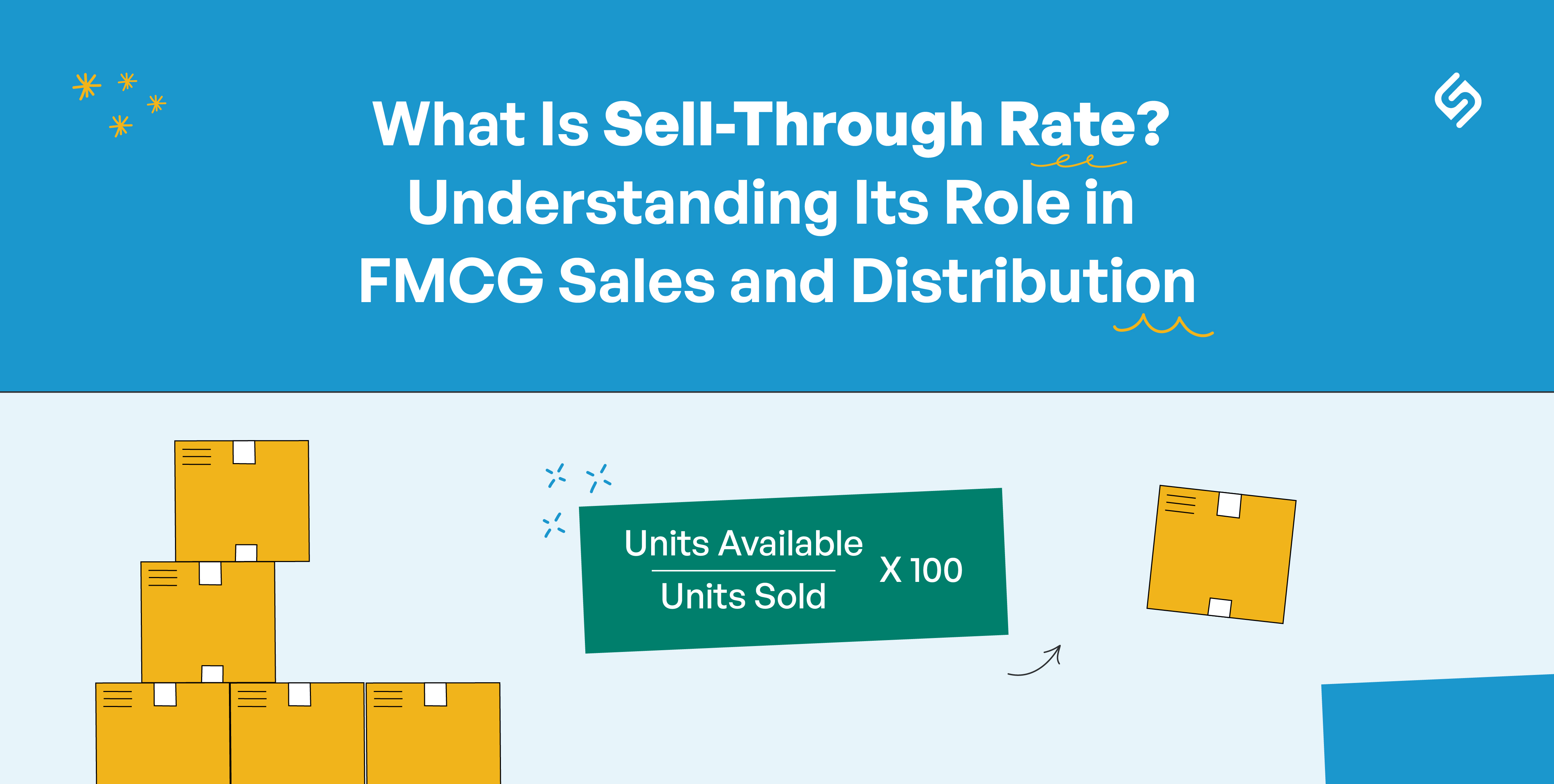
Introduction
In FMCG, strong sales numbers often look impressive on reports. But there’s a critical question most businesses overlook:
Are your products actually selling to consumers or just moving into the distribution channel?
This is where sell-through rate becomes one of the most important metrics for FMCG companies. It shifts the focus from how much you sell to how much actually gets sold.
What Is Sell-Through Rate?
Sell-through rate measures the percentage of inventory that is sold to end customers within a given period, compared to the total stock supplied.
Sell Through Rate Formula
Sell-Through Rate (%) = Units Available / Units Sold × 100
For example, if 1,000 units are distributed and 700 units are sold, the sell-through rate is 70%.
Why Sell-Through Rate Matters in FMCG
FMCG businesses operate on high volume, fast-moving products, and wide distribution networks. In such an environment, relying only on primary sales can be misleading.
1. It reveals real market demand
Primary sales show how much stock is pushed into the market. Sell-through rate shows actual consumer demand.
2. It prevents stock pile-up
Low sell-through often indicates excess inventory at distributor or retailer level, leading to dead stock and expiry risks.
3. It improves inventory planning
With accurate sell-through data, companies can align production and distribution with real consumption patterns.
4. It strengthens secondary sales strategy
Sell-through insights help identify:
✔ Fast-moving products
✔ Slow-moving SKUs
✔ Underperforming territories
The Gap Between Primary Sales and Secondary Sales
One of the biggest challenges in FMCG is the disconnect between:
✔ Primary sales (company → distributor)
✔ Secondary sales (distributor → retailer/consumer)
A business may report high primary sales but still struggle with low product movement in the market.
This gap leads to:
✔ Overstocking
✔ Reduced working capital efficiency
✔ Poor visibility into actual demand
Sell-through rate acts as the bridge between these two realities.
Common Challenges in Tracking Sell-Through Rate
Despite its importance, many FMCG companies struggle to track sell-through accurately.
Lack of real-time data
Traditional systems rely on delayed or manual reporting from distributors.
Limited outlet-level visibility
Without granular data, it’s difficult to understand product movement at the retail level.
Inconsistent reporting
Data gaps make sell-through analysis unreliable and difficult to act upon.
Making Sell-Through Rate Actionable with SFA
Tracking sell-through is only the first step. The real value comes when businesses can act on it quickly and effectively.
This is where Sales Force Automation (SFA) platforms like SalesJump play a critical role.
With the right SFA system, FMCG companies can:
Capture real-time secondary sales
Field teams and distributors update sales data instantly, improving visibility.
Monitor outlet-level performance
Understand which products are moving, where, and why.
Identify low sell-through zones
Quickly detect areas with high stock but low movement.
Enable smarter field execution
Sales reps can:
✔ Focus on slow-moving products
✔ Adjust their sales pitch
✔ Improve product visibility at outlets
Use AI-driven insights
Advanced systems can recommend:
✔ What products to push
✔ Where to restock
✔ How to optimize inventory movement
How FMCG Companies Can Improve Sell-Through Rate
Improving sell-through is not just about pushing more stock-it’s about driving better movement.
✔ Align supply with actual demand
✔ Optimize pricing and promotional schemes
✔ Improve in-store visibility and merchandising
✔ Equip field teams with actionable insights
✔ Continuously monitor secondary sales data
Conclusion
In today’s competitive FMCG landscape, selling to the channel is no longer enough. What matters is how effectively products move from shelves to consumers.
Sell-through rate provides that clarity.
When combined with the right technology and field execution strategy, it becomes more than a metric-it becomes a driver of growth, efficiency, and smarter decision-making.
Frequently Asked Questions
1. What is sell-through rate?
Sell-through rate is the percentage of available inventory that is sold during a specific period. It helps FMCG businesses measure how quickly products move through the sales channel and understand actual product demand.
2. How is sell-through rate calculated?
Sell-through rate is calculated by dividing the number of units sold by the total units available for sale and multiplying the result by 100. For example, if 800 out of 1,000 available units are sold, the sell-through rate is 80%.
3. Why is sell-through rate important for FMCG companies?
Sell-through rate is important for FMCG companies because it shows how effectively products are moving through the market. It helps businesses identify slow-moving products, manage inventory, improve secondary sales, and align supply with actual demand.
4. What is a good sell-through rate?
A good sell-through rate depends on the product category, sales cycle, market, and measurement period. Generally, a higher sell-through rate indicates stronger product movement, while a low rate may signal excess inventory, weak demand, or distribution issues.
5. What is the difference between sell-through rate and sell-in?
Sell-in refers to products sold by a manufacturer to distributors or retailers, while sell-through measures how much of the available inventory is actually sold onward to customers. Sell-in measures channel sales; sell-through provides a clearer view of product movement and market demand.